Seiko
From a working diver’s letter to the 600m quartz and the 1000m Marinemaster.
A watch in a crowded diving bell
In 1968, professional diver Yo Oshima wrote to Seiko about working at 350 metres. The designers eventually met his crew. Two men sharing a bell had little room to move. Cables caught on watches. A knock against steel could damage a crown or crystal. Grease from equipment worked under rotating bezels. These were everyday complaints, and several could happen before a diver even entered the water. Taro Tanaka’s development account, stories 1–6
Seiko built a close-fitting outer guard around the rotating bezel and the one-piece inner case. The guard presented a smoother surface to passing equipment and took the first contact from a sideways knock. Openings gave fingers purchase on the bezel, which a diver set against the minute hand to follow elapsed time. Oshima and fellow divers tried the prototypes and reported back. The mechanical 600m went on sale in June 1975. Seiko Museum, design sketches and prototype trials
What happens inside the case?
A saturation diver may spend days living in a chamber at the pressure of the work site and travel to the job in a pressurized bell. That gives helium in the breathing atmosphere time to penetrate a watch through its seals. During decompression the surrounding pressure falls. Gas remaining in the watch then pushes outward against the crystal. A case that keeps liquid water out can still accumulate gas over days. JAMSTEC technical report, figure 5
The visible shroud handled impacts. Seiko addressed helium deeper inside, using a one-piece titanium body and an L-shaped gasket at the crystal to restrict entry. A second approach used by other makers was to fit a one-way valve that opened as pressure built inside relative to the chamber. On the wrist, another problem emerged as the suit compressed and the strap loosened. Seiko’s corrugated strap could contract to take up slack. Seiko’s construction history
Three tests, three different questions
1982 · How much helium enters a watch?
During JAMSTEC’s Japanese Sea Dragon V experiment, researchers removed the movements from four watch cases, connected pressure gauges through the crowns and suspended the cases in a chamber. They spent three days at the equivalent of 300 metres in a mixture containing 96.5% helium. Measuring the gas pressure inside each case revealed differences that a water tank alone could never show. Minoru Yamada, JAMSTEC Technical Report 13 (1984), methods and table 2
The report labels the cases A through D. Case D, with neoprene seals and a relief valve, registered an internal rise of 5.3 kgf/cm², then vented during decompression. The two-piece case C, with butyl seals, accumulated gas most slowly. The report pictures a Seiko Professional 600. Seiko later identified its 600m as the lowest-ingress performer. Original results, figures 3–5 and photographs · Seiko’s account
1983 · Will the 600m watches work at sea?
In May, two Seiko Professional 600m watches rode outside JAMSTEC’s crewed Shinkai 2000 to 1,062 metres. Seiko reports that both survived and retained their accuracy. Here the water pressed inward on complete watches. The descent answered a different question from the chamber experiment. The collection’s 1980 quartz belongs to the generation introduced in 1978. Seiko’s expedition record · 1978 quartz chronology
2014 · How far would the 1000m examples run?
Two 1000m watches rode outside JAMSTEC’s remotely operated Kaiko 7000II. Seiko reports operation to 3,284 metres for the quartz example and 4,299 metres for the mechanical. Those figures belong to the expedition specimens. The collection’s 2015 Marinemaster Automatic carries its own 1000m rating. Seiko’s recorded depths · See the 1980 and 2015 watches together
Documents and collector references
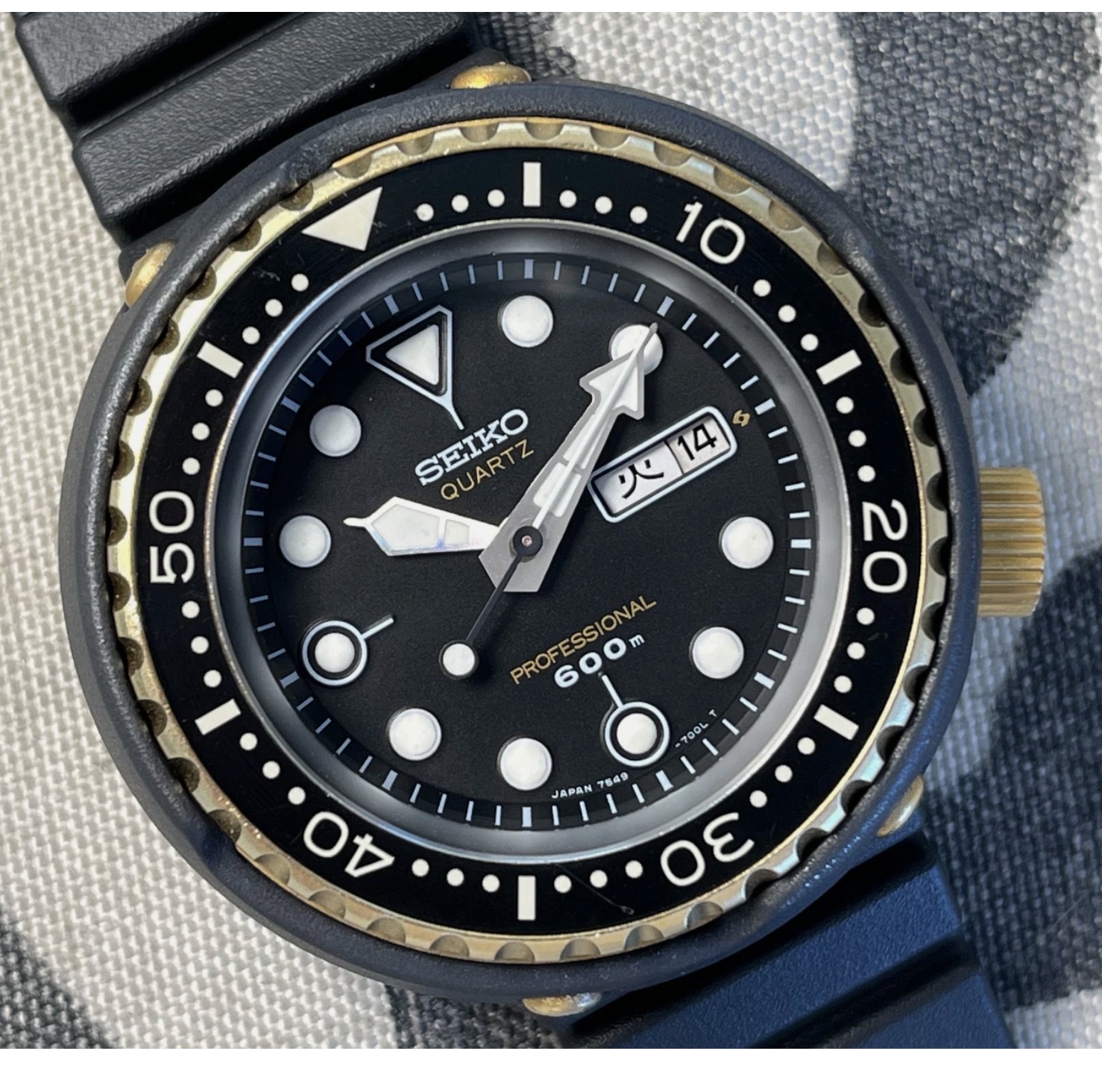
1980 Seiko Quartz 600m
The close-up gives you the dial side. A documented restoration of a related 1978 watch shows what sits behind those oversized hands.
- Adventures in Amateur Watch Fettling · A 1978 Golden Tuna on the bench
- A photographed 7549-7000 teardown follows a stopped quartz watch through diagnosis. Look for the unusually large fittings that carry the hands.
- Plus9Time · The original and the anniversary diver
- A comparison of the original PYF018 and the 2018 interpretation. The outlines around the calendar and hour markers make particularly good comparison points.
- Plus9Time · Japanese dealer catalog scans
- Browse by period and open a catalog from its cover. These scans preserve how Seiko presented its watches to Japanese dealers.
2015 Seiko Automatic 1000m
The two-watch photograph shows a 35-year change at a glance. The 2015 launch documents add the contemporary model names and specifications.
- Seiko Watch Corporation · The 2015 shrouded series announcement
- Original Japanese release covering several variants, including the SBDX014 and SBDX016. The references describe the announced models. The collection piece awaits caseback confirmation.
- Seiko Baselworld press kit · Marinemaster Professional 1000m in English
- English-language factory press material for the SBDX014. Use it alongside the Japanese release and the collection photograph.